



GEYOTO Home Backup Guide: Features and Key Benefits
Power outages can affect essential household activities, from keeping food refrigerated to maintaining internet access, lighting, and communication. A well-planned backup system can provide an alternative source of electricity when utility power is unavailable.
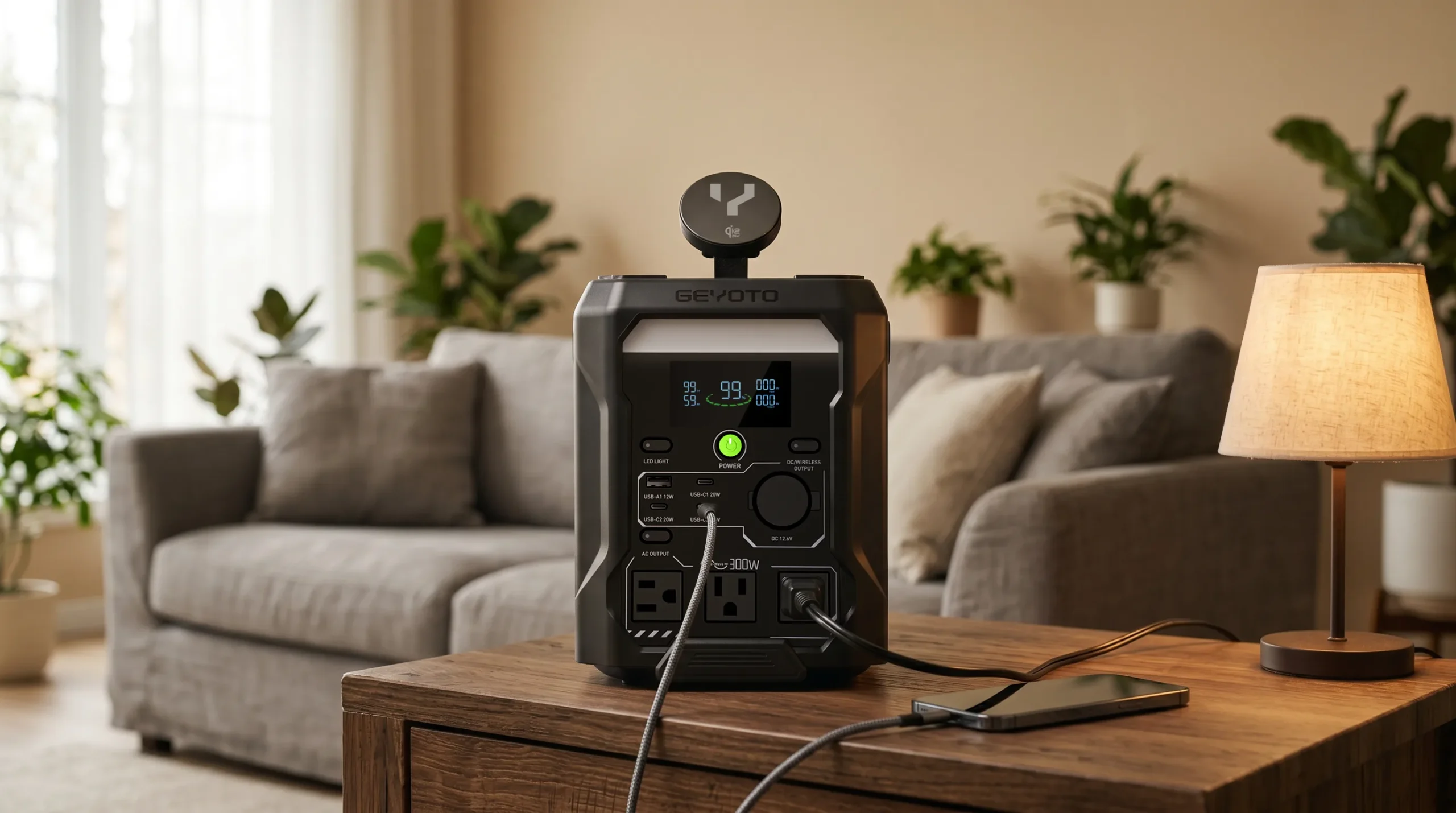
This GEYOTO home backup guide looks at the key features of GEYOTO’s N300 and N1000 portable power stations and explains how their different specifications can fit different backup needs.
Choosing the Right Backup Capacity
One of the first things to consider when selecting a portable power station is battery capacity. Measured in watt-hours (Wh), capacity indicates how much energy the battery can store.
The GEYOTO N300 has a 256Wh capacity and is positioned as a compact “Grab and Go” solution. It is designed for camping, travel, small electronics, Wi-Fi routers, laptops, lighting, and short-term outage backup.
The N1000 provides 1,024Wh of capacity and is positioned as an “All-in-One: One Station. Fully Loaded.” system for higher-capacity applications, including home emergencies, refrigerators, CPAP machines, fans, Wi-Fi equipment, RV trips, camping, and vehicle-support scenarios.
N300: Compact Backup for Essential Devices
The N300 is designed for situations where portability and straightforward access to backup electricity are priorities.
Its 256Wh LiFePO4 battery provides stored energy for compatible low- to moderate-power devices. The unit delivers 300W of continuous pure sine wave output and 500W peak output.
It also includes a 550W Constant Power mode for compatible loads within the specified operating conditions. This can provide additional flexibility for certain devices, although higher-power operation can reduce available runtime more quickly.
N1000: Higher-Capacity Home Backup
The N1000 is designed for households that need more stored energy and higher power output.
It provides 1,024Wh of capacity, 1,800W of continuous pure sine wave output, and 3,000W peak output. Its 2,400W Constant Power mode can provide additional flexibility for compatible higher-power loads within the specified operating range.
This makes the N1000 suited to broader emergency applications, including refrigerators, CPAP machines, fans, Wi-Fi equipment, and other essential household devices when their requirements fall within the system’s supported limits.
LiFePO4 Battery Technology
Both the N300 and N1000 use LiFePO4 batteries and have a specified battery life of 4,000 cycles.
Cycle life is an important specification for users who expect to repeatedly charge and discharge a portable power station. Actual battery service life can vary based on temperature, charging practices, storage conditions, operating conditions, and usage.
For regular emergency preparedness, following the manufacturer’s charging and storage recommendations is important.
Fast Recharge for Emergency Preparedness
Recharge speed can be especially valuable when outages occur repeatedly or when electricity is restored only temporarily.
The N300 can fully recharge in about 1.5 hours. The N1000 can reach 0–80% charge in 43 minutes and 100% charge in 68 minutes.
A shorter recharge period can make it easier to prepare the system for another interruption after utility service returns.
Multiple Ports for Different Devices
The number and variety of available connections affect how flexibly a portable power station can be used.
The N300 provides nine output outlets and 25W wireless charging. The N1000 provides 18 total ports and interfaces, including 13 output ports, along with Qi2.2 25W wireless charging.
This range of connections can be useful when several types of devices need power during an outage or when the same system is used for outdoor activities.
UPS Switching for Connected Electronics
Both GEYOTO models have a specified UPS switching time of less than 10 milliseconds.
UPS functionality can help reduce interruptions when utility power fails. This can be useful for compatible equipment such as Wi-Fi routers, computers, and other electronics that may restart when power is interrupted.
Compatibility depends on the connected device, so users should check equipment requirements and follow the manufacturer’s guidance.
Pure Sine Wave Output
Both the N300 and N1000 provide pure sine wave AC output.
Pure sine wave output is designed to provide a waveform similar to utility electricity and can be an important consideration when powering electronics or appliances with specific electrical requirements.
Before connecting any sensitive equipment, users should verify its requirements and ensure the portable power station is suitable for the application.
Vehicle-Support Capability
The N1000 is designed for uses beyond home emergency backup.
It includes an XT60 vehicle-support output rated at 12.6V/30A, with up to 378W of output for compatible vehicle-support applications.
This can add flexibility for users who want a portable power station that can be used for home emergencies as well as compatible outdoor, RV, camping, and vehicle-support needs.
Common Home Backup Applications
Depending on the model and power requirements, GEYOTO portable power stations can support a range of essential household devices.
Refrigerators
Refrigerators can be an important priority during extended outages. Before connecting one, check its running and startup requirements against the power station’s continuous and peak output capabilities.
Wi-Fi Equipment
Routers and modems generally require relatively modest amounts of power. Keeping them operational can help maintain internet access for communication, work, and access to emergency information.
Lighting and Fans
Lighting can help maintain basic visibility during nighttime outages, while fans may provide useful airflow when conventional household systems are unavailable.
Laptops and Communication Devices
Portable power stations can help keep laptops, phones, and other compatible electronics charged during an outage, helping households remain connected.
CPAP Machines
The N1000 is positioned for applications including CPAP machines. Users should verify the specific electrical requirements of their medical equipment before relying on a portable power station for continuous operation.
Portability and Flexible Use
A backup system does not always need to remain in one location. Portable power stations can be useful at home, during travel, and for outdoor activities.
The N300’s compact “Grab and Go” positioning makes it suitable for users who prioritize portability. The N1000 provides greater capacity and output for users who need broader backup capabilities while also supporting compatible outdoor and vehicle-related applications.
Matching the Model to Your Needs
The N300 and N1000 serve different roles, so the choice should be based on actual power requirements rather than simply selecting the larger system.
The N300 can be a practical choice for smaller electronics, lighting, Wi-Fi equipment, laptops, camping, travel, and short-term backup. The N1000 is better suited to higher-capacity requirements where greater stored energy and output are needed.
Consider these factors before choosing:
- Essential appliances and devices
- Combined running wattage
- Startup power requirements
- Expected outage duration
- Required battery capacity
- Recharge speed
- Number and type of ports
- Portability requirements
- Outdoor or vehicle-support needs
Final Thoughts
A home backup system is most useful when its specifications match the equipment you actually need to operate. The GEYOTO N300 focuses on compact, portable backup, while the N1000 provides substantially more capacity and output for broader emergency and outdoor applications.
Understanding capacity, continuous and peak output, Constant Power, battery technology, recharge speed, ports, UPS switching, and intended uses can help you select the system that best fits your backup requirements and prepare more effectively for unexpected power interruptions.