



How to Calculate the Return on Investment for Inflatable Games for Sale
Investing in inflatable games can be an attractive opportunity for entrepreneurs who want to start or expand an event rental business. These attractions are commonly used at birthday parties, school fairs, festivals, corporate gatherings, and community celebrations. However, purchasing equipment is only the first step. To determine whether an investment is financially worthwhile, business owners need to understand the costs involved, estimate potential revenue, and calculate the time required to recover their initial investment.
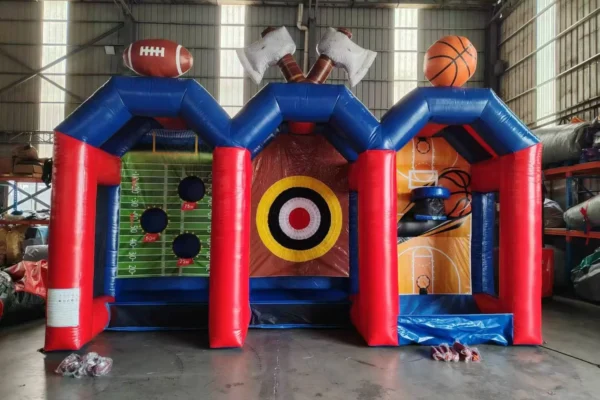
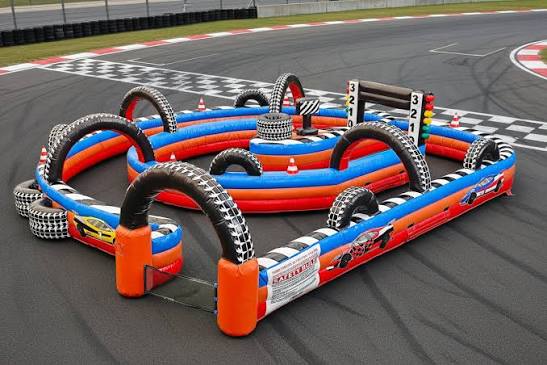
When comparing Inflatable Games for Sale, buyers should evaluate more than the purchase price. Rental demand, booking frequency, transportation, maintenance, staffing, and equipment lifespan can all affect profitability. By using a structured return on investment calculation, you can compare different products and make more informed purchasing decisions.
What Is Return on Investment for Inflatable Games?
Return on investment, commonly known as ROI, measures the financial return generated by an investment relative to its cost. For an inflatable game rental business, ROI helps show whether the revenue earned from renting equipment is sufficient to justify the money spent on purchasing and operating it.
The basic ROI formula is:
ROI = (Net Profit ÷ Total Investment Cost) × 100
Net profit is the revenue remaining after subtracting the relevant expenses from the income generated by the inflatable game over a defined period.
For example, if you invest $4,000 in an inflatable game and generate $1,000 in net profit over one year, your annual ROI would be 25%.
This calculation provides a useful starting point, but the result is only as reliable as the figures used. Buyers should include realistic costs and booking estimates rather than assuming the equipment will be rented every weekend.
Step 1: Calculate the Initial Investment Cost
The first step is to determine how much money you need to purchase and prepare the inflatable game for commercial use. The advertised price may not include every expense required to make the equipment operational.
Your initial investment may include:
- Purchase price of the inflatable game.
- Shipping, delivery, and applicable import duties.
- Blower and required accessories.
- Anchoring equipment and installation supplies.
- Initial inspection or setup expenses.
- Storage preparation and transportation equipment.
- Business registration, permits, or insurance setup costs where applicable.
For example, suppose you purchase an inflatable obstacle course for $3,000. Shipping costs $300, the required accessories cost $200, and initial setup expenses total $100.
Your initial investment would be:
| Expense | Cost |
|---|---|
| Inflatable game | $3,000 |
| Shipping | $300 |
| Accessories | $200 |
| Initial setup | $100 |
| Total initial investment | $3,600 |
In this example, the actual investment is $3,600 rather than the advertised product price of $3,000.
Accurately calculating the initial cost helps you establish a realistic financial target and compare products on an equal basis.
Step 2: Estimate the Rental Price per Booking
The next step is to determine how much revenue the inflatable can generate each time it is rented.
Rental prices vary according to the type of attraction, location, booking duration, season, customer demand, delivery distance, and level of service provided.
For example, a small inflatable game rented for a private birthday party may command a different rate from a large obstacle course used at a corporate event or festival.
To establish a reasonable rental price, research competing rental businesses in your target market. Compare similar products and consider what your service includes, such as delivery, setup, collection, and supervision.
Suppose you plan to charge $250 per booking for a particular inflatable game. This figure represents your gross revenue per booking, not your profit. You must still account for the costs associated with delivering and operating the attraction.
Use actual market research whenever possible, and avoid setting prices based solely on what you hope customers will pay.
Step 3: Estimate Monthly and Annual Booking Frequency
Booking frequency is one of the most important factors affecting the return on an inflatable game investment. Even a high rental price may not produce an attractive ROI if the equipment receives very few bookings.
Estimate how often customers are likely to rent the product during different times of the year. Consider local demographics, event seasons, school calendars, weather conditions, competition, and the types of customers you intend to serve.
For a simple example, assume the inflatable receives six bookings per month at $250 per booking.
Monthly gross revenue would be:
6 bookings × $250 = $1,500
If the business operates at a similar level for 12 months, annual gross revenue would be:
$1,500 × 12 = $18,000
However, rental demand rarely remains constant throughout the year. A better forecast may use separate estimates for peak, average, and slower months.
When planning your investment, prepare conservative, moderate, and optimistic booking scenarios. This approach helps you understand how changes in demand could affect profitability.
Step 4: Calculate the Operating Costs
Gross revenue does not represent the amount of money you earn from the inflatable. Every booking can involve expenses, and some costs continue even when the equipment is not rented.
Operating expenses may include:
- Delivery and collection.
- Fuel and vehicle expenses.
- Staff wages and setup labor.
- Cleaning and drying.
- Routine inspections and maintenance.
- Repairs and replacement components.
- Storage and equipment handling.
- Insurance and applicable business fees.
- Advertising and booking administration.
Suppose each rental generates $250 in revenue and costs $70 to deliver, install, clean, and prepare for the next booking.
Your contribution per booking would be:
$250 − $70 = $180
If you receive six bookings per month, the monthly contribution would be:
6 × $180 = $1,080
This amount is available to cover fixed business expenses and contribute toward recovering the investment. It should not automatically be treated as net profit if additional expenses have not yet been included.
Separating variable costs from fixed costs makes your financial calculations more accurate.
Step 5: Calculate the Net Profit
Once you estimate revenue and operating expenses, calculate the net profit generated over the period you want to evaluate.
For a straightforward annual estimate, use the following formula:
Annual Net Profit = Annual Revenue − Annual Operating Expenses
Suppose an inflatable generates $18,000 in annual rental revenue. Its variable operating expenses total $5,040, while annual fixed expenses allocated to the equipment total $2,160.
The calculation would be:
| Financial Item | Annual Amount |
|---|---|
| Gross rental revenue | $18,000 |
| Variable operating expenses | $5,040 |
| Allocated fixed expenses | $2,160 |
| Estimated annual operating profit | $10,800 |
In this example, the inflatable generates $10,800 in annual operating profit before any additional costs not included in the estimate.
Depending on the purpose of your analysis, you may also need to account for financing costs, taxes, depreciation, and the value of your own labor. Be consistent about which expenses are included when comparing different products.
Step 6: Calculate the ROI Percentage
After determining the initial investment and the net profit for the period, you can calculate the return on investment.
Using the earlier example:
- Initial investment: $3,600
- Estimated annual operating profit: $10,800
The simple annual ROI calculation is:
ROI = ($10,800 ÷ $3,600) × 100
Estimated annual ROI = 300%
This is an illustrative result, not a guarantee of actual performance. It assumes the business achieves the stated revenue and expense estimates throughout the year.
The example also shows why it is important to distinguish between a product’s purchase price and its full investment cost. If the equipment generates the same profit but the initial investment is higher, the ROI percentage will be lower.
For a more accurate assessment, include all relevant expenses and use realistic demand estimates. If you are comparing different investments, make sure each ROI figure covers the same period and follows the same accounting assumptions.
Step 7: Estimate the Payback Period
ROI measures the return relative to the investment, while the payback period estimates how long it takes to recover the initial amount spent.
A simple payback formula is:
Payback Period = Initial Investment ÷ Average Periodic Net Cash Flow
Suppose an inflatable requires an initial investment of $3,600 and generates an average of $600 in monthly net cash flow after the operating expenses included in your estimate.
The payback period would be:
$3,600 ÷ $600 = 6 months
Under these assumptions, the investment would take approximately six months to recover.
This is a simplified calculation. Actual payback may take longer because bookings can fluctuate, repairs may occur unexpectedly, and seasonal demand may reduce income during certain periods.
For a more reliable estimate, use month-by-month cash flow projections rather than assuming that every month produces the same result.
Step 8: Compare Different Inflatable Games Before Buying
Not every inflatable offers the same earning potential. A large obstacle course may command a higher rental price, but it can also involve greater purchase, transportation, staffing, and storage expenses.
A smaller interactive game may generate less revenue per booking but cost less to operate and fit into more venues.
When comparing potential purchases, evaluate the following factors:
| Factor | Why It Matters |
|---|---|
| Purchase cost | Determines the initial financial commitment |
| Average rental price | Influences revenue per booking |
| Expected booking frequency | Determines how often revenue is generated |
| Operating expenses | Reduce the amount available as profit |
| Setup time | Affects labor costs and scheduling |
| Storage and transportation | Influence ongoing operating costs |
| Maintenance requirements | Affect expenses and equipment availability |
| Expected service life | Helps assess longer-term value |
| Seasonal demand | Influences monthly cash flow |
A product with a lower ROI percentage may still be attractive if it generates a larger amount of profit, serves a different customer segment, or complements the rest of your rental inventory.
Use both ROI and estimated cash flow when comparing products rather than relying on a single number.
Step 9: Account for Seasonality and Equipment Downtime
Inflatable rental businesses can experience changes in demand throughout the year. Warm-weather months, school holidays, weekends, and festival periods may generate more bookings than quieter periods.
Weather can also affect whether an outdoor inflatable can be operated safely. Strong winds, lightning, and other unsuitable conditions may require cancellations or temporary closures.
Equipment downtime can reduce revenue when an inflatable needs repairs, maintenance, or replacement parts. These risks should be included in your financial projections.
To manage uncertainty, consider the following practices:
- Use conservative booking estimates for slower months.
- Maintain a budget for unexpected repairs.
- Follow the manufacturer’s inspection and maintenance instructions.
- Establish clear cancellation and rescheduling policies.
- Avoid relying on one product or customer group for all revenue.
- Track actual booking frequency and expenses over time.
A financial forecast that accounts for downtime and seasonal variation is more useful than one based on uninterrupted operation.
Step 10: Consider the Long-Term Value of the Equipment
An inflatable game may continue generating revenue for several years if it is properly maintained and remains suitable for its intended use. However, its service life depends on construction quality, frequency of use, handling, storage, environmental exposure, and maintenance.
When estimating long-term value, consider how much revenue the equipment could generate over its expected service life and how much it may cost to maintain.
You should also account for the possibility of resale value at the end of the investment period. A well-maintained product with complete documentation may retain some value, although resale prices depend on demand, condition, age, and the availability of newer models.
For a more comprehensive evaluation, compare the expected cash flows over several years. This can help you determine whether a more expensive but durable model offers better value than a cheaper product with higher maintenance requirements.
If you are considering financing, customized equipment, or a large commercial attraction, you may also benefit from a discounted cash flow analysis that accounts for the time value of money.
Common Mistakes When Calculating ROI
Financial calculations can become misleading if important costs or business conditions are overlooked.
Confusing Revenue with Profit
Revenue is the total amount earned from bookings. Profit is what remains after the relevant expenses are deducted. Using revenue in place of profit can significantly overstate ROI.
Overestimating Booking Frequency
Assuming the inflatable will be rented every weekend may create unrealistic expectations. Use local market research and account for seasonal demand, competition, and cancellations.
Ignoring Hidden Costs
Delivery, labor, repairs, insurance, storage, and cleaning can all affect the final result. Include these expenses when comparing products.
Forgetting Equipment Downtime
An inflatable cannot generate rental income while it is unavailable for repairs or unsuitable weather conditions. Allow for these interruptions in your projections.
Focusing Only on the ROI Percentage
A high ROI percentage does not always mean an investment generates the most cash. Compare absolute profit, cash flow, payback period, risk, and expected service life as well.
Avoiding these mistakes can help you build a more realistic financial plan and make better purchasing decisions.
Conclusion
Calculating the return on investment for inflatable games involves estimating the full purchase cost, expected rental revenue, booking frequency, operating expenses, and net profit. You can then use these figures to calculate ROI and estimate the time needed to recover the initial investment.
When evaluating different products, consider more than the advertised price or potential rental rate. Transportation, maintenance, storage, weather-related interruptions, and equipment lifespan all influence the financial outcome.
By comparing realistic financial scenarios and tracking actual business performance, rental operators can identify which attractions best match their budget and customer demand. Careful planning will not guarantee profitability, but it can reduce uncertainty and support more informed decisions when purchasing inflatable games.