






When to Use a D Curve MCB for High-Inrush Current Electrical Equipment
Selecting the correct circuit breaker is essential for maintaining electrical safety and preventing unnecessary power interruptions. Different electrical loads draw different amounts of current during operation, and some equipment requires a particularly high current when it first starts. This temporary increase, known as inrush current, can cause an unsuitable circuit breaker to trip even when the equipment is operating normally. A D Curve Miniature Circuit Breaker (MCB) is designed to handle these demanding starting conditions while still providing protection against overloads and short circuits.
Understanding when to use a D Curve Mcb helps electricians, engineers, and facility managers choose suitable protection for equipment with high starting currents. Compared with B Curve and C Curve MCBs, a D Curve device has a higher instantaneous magnetic tripping threshold. This makes it useful for specific applications involving motors, transformers, compressors, and other electrical equipment that produces significant current surges during startup.
What Is a D Curve MCB?
A D Curve MCB is a type of miniature circuit breaker designed for electrical circuits with high inrush current requirements. Like other MCBs, it protects circuits against overloads and short circuits.
The main difference between B, C, and D Curve MCBs is their instantaneous magnetic tripping range. This characteristic determines how much short-duration current the breaker can tolerate before its magnetic mechanism disconnects the circuit.
According to commonly used IEC 60898-1 characteristics:
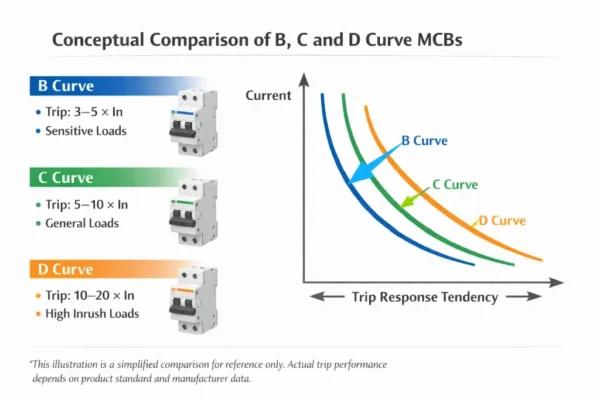
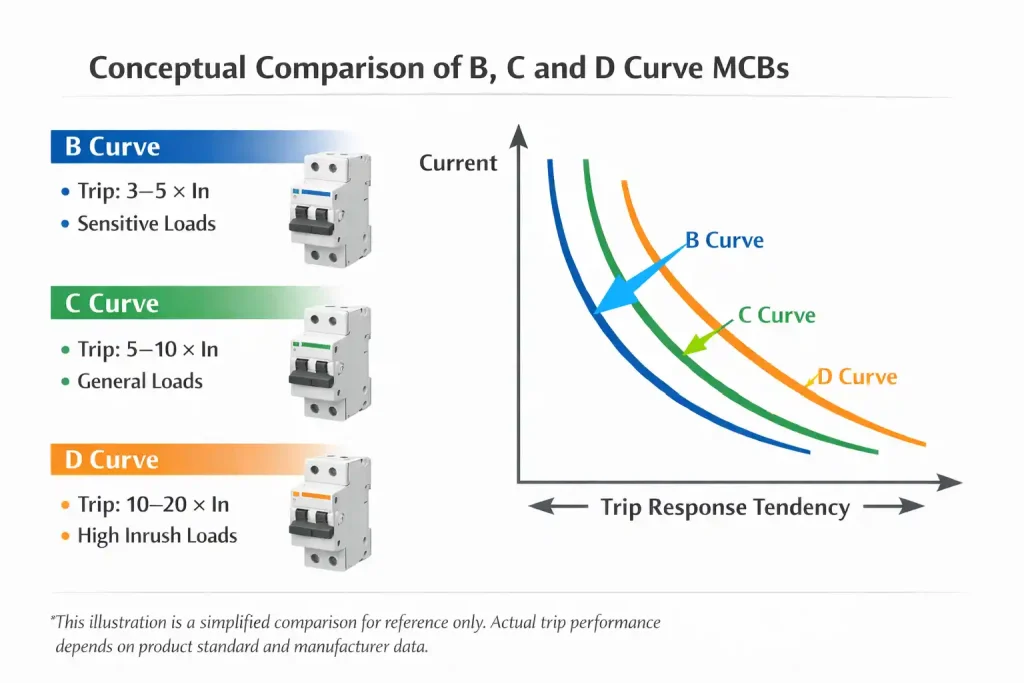
- B Curve: Instantaneous magnetic tripping generally occurs at 3 to 5 times the rated current.
- C Curve: Instantaneous magnetic tripping generally occurs at 5 to 10 times the rated current.
- D Curve: Instantaneous magnetic tripping generally occurs at 10 to 20 times the rated current.
These ranges help explain why D Curve MCBs are suitable for certain high-inrush applications. However, the higher magnetic threshold does not mean that a D Curve breaker is suitable for every circuit. Proper cable protection, fault current assessment, and disconnection requirements must always be considered.
Understanding Inrush Current
Inrush current is the temporary surge of electrical current that occurs when certain equipment is switched on. It may be significantly higher than the current drawn during normal operation.
This surge can occur because of several electrical and mechanical characteristics, including motor startup conditions, transformer magnetization, and the charging of capacitors.
Common causes of high inrush current include:
Motor Starting
When an electric motor starts, it may draw several times its normal running current. This happens because the motor initially has little or no rotational back electromotive force to limit current flow.
As the motor accelerates, the current usually decreases toward its normal operating level.
Transformer Energization
When a transformer is connected to an electrical supply, its magnetic core requires an initial magnetizing current. Depending on switching conditions, residual magnetism, and transformer design, this current can temporarily become much higher than the normal operating current.
Capacitor Charging
Equipment containing large capacitors may draw a high current when first connected to a power supply. This is common in power electronics, industrial control equipment, and certain power supply systems.
Compressor and Pump Startup
Refrigeration compressors, industrial pumps, and similar equipment may require high starting current, particularly when operating under demanding mechanical or pressure conditions.
If the selected MCB cannot tolerate the normal startup surge, it may trip unnecessarily. A suitable D Curve breaker can help accommodate these temporary conditions when the overall protection design allows it.
How Does a D Curve MCB Work?
A D Curve MCB generally uses two main protective mechanisms: thermal protection for overloads and magnetic protection for short circuits.
1. Thermal Protection Against Overloads
The thermal mechanism usually contains a bimetallic strip that responds to excessive current.
When a circuit carries more current than its rated capacity for an extended period, the strip heats up and bends. Once it reaches the operating point, it activates the trip mechanism and opens the circuit.
This helps protect electrical cables and connected equipment from damage caused by sustained overload conditions.
2. Magnetic Protection Against Short Circuits
The magnetic mechanism responds to sudden increases in current.
In a D Curve MCB, the instantaneous magnetic tripping range is generally between 10 and 20 times the rated current under the relevant standard. This higher threshold helps prevent normal startup surges from causing unnecessary magnetic tripping.
However, the breaker must still be capable of disconnecting a genuine short circuit within the required time. This is why the prospective fault current and circuit impedance must be evaluated during selection.
When Should You Use a D Curve MCB?
D Curve MCBs are most appropriate when equipment produces high startup currents that may cause B Curve or C Curve breakers to trip unnecessarily.
The following applications are common examples.
1. Large Electric Motors
Industrial motors can draw substantial current during startup, especially when they are connected directly to the supply.
A D Curve MCB may be suitable for certain motor circuits where the starting current exceeds the instantaneous tripping range of a C Curve device.
However, motor circuits often require additional protection, such as overload relays or motor protection devices. The MCB should not be treated as a complete replacement for dedicated motor overload protection.
2. Transformers
Transformers may experience high magnetizing inrush current when energized. A D Curve MCB can sometimes accommodate this temporary surge more effectively than a lower-curve breaker.
The selection should account for transformer capacity, energization characteristics, cable protection, and available short-circuit current.
3. Industrial Compressors
Air compressors and refrigeration compressors can draw high starting currents, depending on their motor design and operating conditions.
A D Curve MCB may help reduce unwanted tripping during startup when the compressor’s current characteristics justify its use.
4. Welding Equipment
Some welding equipment produces high and fluctuating current demands. Certain transformer-based welding machines may also experience substantial startup surges.
A suitably selected D Curve MCB may be appropriate, depending on the equipment manufacturer’s recommendations and the electrical installation requirements.
5. Large Pumps
Industrial water pumps and other motor-driven pumping systems may require high current during startup.
D Curve protection may be useful when the starting current is high enough to exceed the instantaneous threshold of a C Curve breaker. Engineers must also consider motor starting methods, overload protection, and fault disconnection requirements.
6. Equipment with Large Capacitive Loads
Certain power supplies, electronic systems, and capacitor-based equipment can draw significant current when initially energized.
A D Curve MCB may be considered where the measured or specified inrush current requires a higher instantaneous tripping threshold.
D Curve vs. B Curve and C Curve MCBs
Choosing between B, C, and D Curve MCBs depends on the characteristics of the connected load.
| Feature | B Curve | C Curve | D Curve |
|---|---|---|---|
| Magnetic tripping range | 3–5 times rated current | 5–10 times rated current | 10–20 times rated current |
| Typical application | Resistive and low-inrush loads | General commercial and industrial loads | High-inrush electrical equipment |
| Motor applications | Small motors with low starting current, where suitable | Many general motor circuits, subject to design | Motors with higher starting current, where suitable |
| Transformer applications | Limited to suitable low-inrush conditions | Suitable for some transformer circuits | Often considered for higher transformer inrush |
| Startup surge tolerance | Lower | Moderate | Higher |
A higher curve does not automatically provide better protection. The correct choice must balance the load’s starting characteristics with the need to disconnect fault currents quickly.
Important Factors to Consider Before Selecting a D Curve MCB
Although D Curve MCBs can accommodate high inrush currents, they should only be used when the electrical installation can support their protection characteristics.
Several factors should be evaluated.
Rated Current
The MCB’s rated current must be suitable for the circuit’s normal operating load and the current-carrying capacity of the connected conductors.
Selecting an unnecessarily high current rating can compromise cable protection.
Starting Current
The magnitude and duration of the equipment’s startup current should be checked. Manufacturer specifications or measurements can help determine whether a D Curve MCB is necessary.
Prospective Short-Circuit Current
The available fault current at the installation point must be sufficient for the selected breaker to operate within the required disconnection time.
A D Curve MCB’s higher magnetic threshold can make fault disconnection more challenging in circuits with relatively low fault current.
Cable Size and Installation Conditions
The cable must be correctly sized for the load, installation method, ambient temperature, and protective device rating.
The relationship between cable capacity and breaker characteristics is essential for safe circuit design.
Breaking Capacity
The MCB’s rated short-circuit breaking capacity must be adequate for the prospective fault current at its installation point.
Applicable Electrical Standards
The selected breaker should comply with relevant product standards and local installation regulations. Its trip characteristics must also be coordinated with other protective devices in the electrical system.
Common Mistakes When Using D Curve MCBs
Incorrect selection can reduce electrical safety and cause problems during operation. Some common mistakes include:
- Using a D Curve MCB for every motor: Not all motors produce sufficiently high startup currents to require D Curve protection.
- Ignoring fault current levels: A high magnetic tripping threshold may prevent sufficiently fast operation when the available fault current is too low.
- Selecting an oversized breaker: The rated current must remain compatible with the cable’s capacity and circuit design.
- Ignoring overload protection: Some motor and industrial applications require dedicated overload relays or other protective equipment.
- Failing to consider manufacturer recommendations: Equipment specifications can provide important information about starting current and suitable protection.
- Replacing a frequently tripping breaker without investigating the cause: Repeated tripping may indicate a genuine electrical or mechanical fault.
A qualified electrician or electrical engineer should evaluate the installation before changing the breaker curve.
Installation and Maintenance Considerations
Proper installation is necessary to ensure that a D Curve MCB performs reliably.
The breaker should be installed in a compatible distribution board and connected according to the manufacturer’s instructions. Before energizing the circuit, the installer should verify conductor sizing, terminal connections, polarity where applicable, and the protective earthing arrangement.
Regular inspection can help identify signs of overheating, loose connections, physical damage, or other problems.
Important maintenance practices include:
- Inspect the MCB and distribution board for visible damage.
- Check terminals and connections according to manufacturer guidance.
- Investigate unexpected or repeated tripping.
- Verify that the breaker remains suitable for the connected load.
- Confirm that fault protection and disconnection requirements are satisfied.
- Replace defective equipment with an appropriately rated device.
Electrical work should be performed by qualified personnel using suitable safety procedures.
Conclusion
A D Curve MCB is designed for electrical circuits that experience high startup currents. Its higher instantaneous magnetic tripping threshold makes it useful for selected applications involving large motors, transformers, compressors, pumps, welding equipment, and capacitive loads.
However, selecting a D Curve breaker requires more than identifying equipment with a high inrush current. Rated current, cable capacity, prospective short-circuit current, breaking capacity, and disconnection requirements must all be considered.
When correctly selected and installed, a D Curve MCB can help prevent unnecessary startup tripping while maintaining essential overload and short-circuit protection. A professional electrical assessment is the best way to ensure that the chosen device provides reliable protection for the specific application.